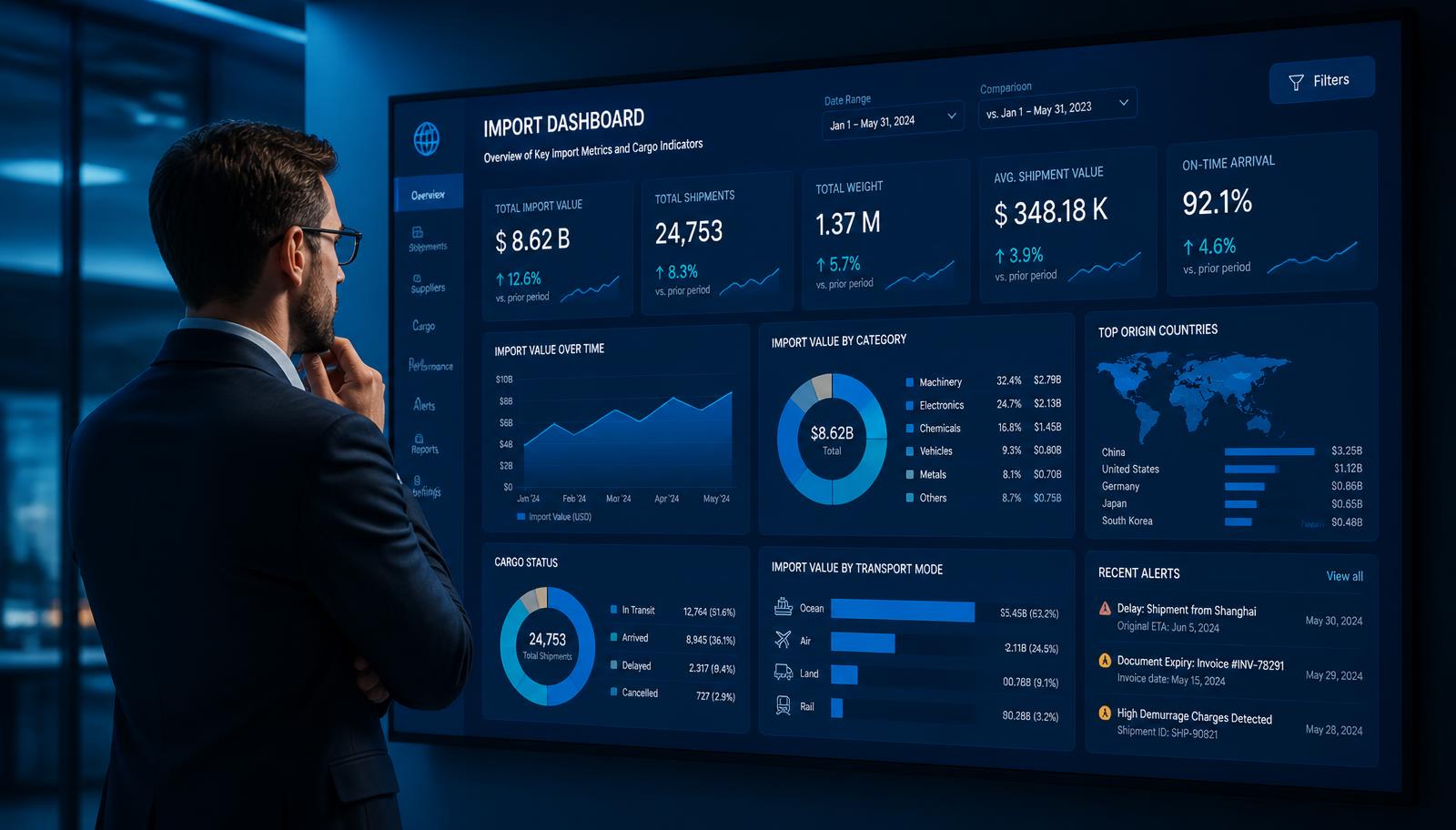
When import data stops being files and becomes insight

Importers in Brazil are surrounded by information. Documents, records, values, origins, routes, deadlines, modals, customs clearance. The problem isn't lack of data. The problem is too much data without interpretation.
In practice, this means many companies run recurring imports, accumulate history in Siscomex, and still struggle to answer simple but decisive questions. Where did costs vary most? Which supplier has been putting more pressure on operations? Which route has been extending lead times? Where is there deviation and where is there a pattern?
This is exactly the gap that the new Comex Dashboard in the Portal Comex fills.
The proposal is to organize import data in a logic that allows seeing operations with more depth. Instead of looking at isolated records, the importer gains an integrated view across cost, logistics, time, and operational performance.
This changes the type of conversation the company can have internally.
Out goes fragmented reading that requires manual effort to compare periods, suppliers, and routes. In comes a clearer view of import evolution over time, with the ability to drill down to the Import Declaration level.
The most relevant point here isn't technological. It's managerial.
When the company can navigate through IDs, remove atypical operations from the analysis, and export readings for strategic materials, it stops looking at imports as a sequence of events and starts treating them as a system that can be observed, compared, and improved.

This advance is especially important because some of the most relevant import decisions don't originate at the moment of contracting. They originate earlier, when the manager tries to understand why an operation cost more, why a supplier performs worse, why a route extended deadlines, or why certain months concentrated greater financial pressure.
Without structured reading, these answers become perception. With structured reading, they become management.
The new Comex Dashboard in the Portal Comex was designed for this: transforming history into operational intelligence.
Evolução Temporal de Importações
Análise de valores FOB e tributos pagos ao longo do tempo
Distribuição por país de origem
Top 5 países em valor FOB
Composição da carga tributária
Distribuição de tributos
In practice, the user can track cost evolution, analyze variations between periods, compare exporters and countries of origin, understand the impact of routes and modals, observe lead times, and deepen the analysis whenever necessary.
There is also an important gain in precision. By allowing the removal of non-standard operations, such as samples or exceptional movements, the analysis becomes less contaminated by events that don't represent the routine of the operation.
It's a technical detail, but with a direct effect on the quality of the reading.
More than a dashboard: an interpretation instrument
In the end, what Vixtra is delivering here is more than a dashboard. It's delivering an interpretation instrument.
In an environment where cost, deadlines, and predictability constantly pressure imports, having access to data is insufficient. The differentiator is being able to read that data in a useful, practical, and actionable way.
That's what makes an operation evolve.
Talk to a Vixtra specialist and discover how the Comex Dashboard can transform your import management.